5 Proven Ways to Increase Average Order Value on Shopify
Namkos Team
Summary: Most Shopify merchants focus on driving more traffic. But increasing average order value (AOV) is often faster, cheaper, and more profitable. This guide covers 5 proven strategies to increase AOV without running endless discounts, including free shipping thresholds, progress bars, product bundling, cart upsells, and tiered rewards.
Your marketing budget is stretched. Traffic costs keep climbing. But here's something most merchants overlook: you don't need more visitors to make more money. You need the visitors you already have to spend a little more.
That's what average order value is all about. And the gap between what your customers currently spend and what they could spend is one of the most underutilised opportunities in e-commerce.
Most Shopify stores leave real money on the table. Your AOV is probably 20-30% lower than it could be, not because of pricing, but because of a few simple things you haven't set up yet. Here are five strategies that work, without touching your margins.
Key Takeaways
📌 AOV is one of the highest-leverage metrics in e-commerce. A $10 increase across 100 daily orders is an extra $30,000 per month.
📌 Discounting everything to drive spend is a margin trap. These strategies increase order value without reducing what you earn per sale.
📌 Strategies 1, 2, and 5 can be implemented today with a free progress bar tool. Strategies 3 and 4 take slightly more setup but pay off consistently.
What Is Average Order Value (And Why It Matters)?
Average order value (AOV) is the average amount a customer spends in a single transaction at your store. You calculate it by dividing total revenue by the number of orders in a given period.
AOV matters because it directly affects your profitability without requiring more ad spend or more traffic. If your current AOV is $45 and you increase it to $55, that's a 22% revenue lift on the exact same number of customers.
A $10 AOV increase might not sound dramatic. But across 50 orders per day, that's an extra $500 daily, $15,000 per month, and $180,000 per year, with zero additional traffic cost.
That's why AOV is worth obsessing over.
Strategy 1: Set a Free Shipping Threshold
What it is: Instead of offering free shipping to everyone, set a minimum order value customers must reach to earn it. For example, "Free shipping on orders over $50."
Why it works: Customers who know they can earn free shipping will actively look for something to add to their cart to reach the threshold. It reframes the decision from "Do I want to pay for shipping?" to "What else can I get to earn free shipping?" That mental shift is where AOV grows.
How to implement it:
- Check your current AOV. If it's $40, set your threshold at $50-55, high enough to stretch the average but still reachable.
- Set up a shipping rule in your Shopify admin under Settings > Shipping & Delivery. Create a rate condition based on order price.
- Communicate the threshold everywhere: at the top of your store, on product pages, and in the cart.
The threshold itself only works if customers know about it. A quiet shipping rule that nobody sees won't move your AOV. That's where the next strategy comes in.
A quick note on margins: Make sure the cost of offering free shipping at your threshold doesn't exceed the extra revenue gained. For most stores, a threshold set at 20-30% above current AOV pays for itself. Results vary based on niche, average product weight, and shipping carrier rates.
Strategy 2: Add a Progress Bar to Show Customers How Close They Are
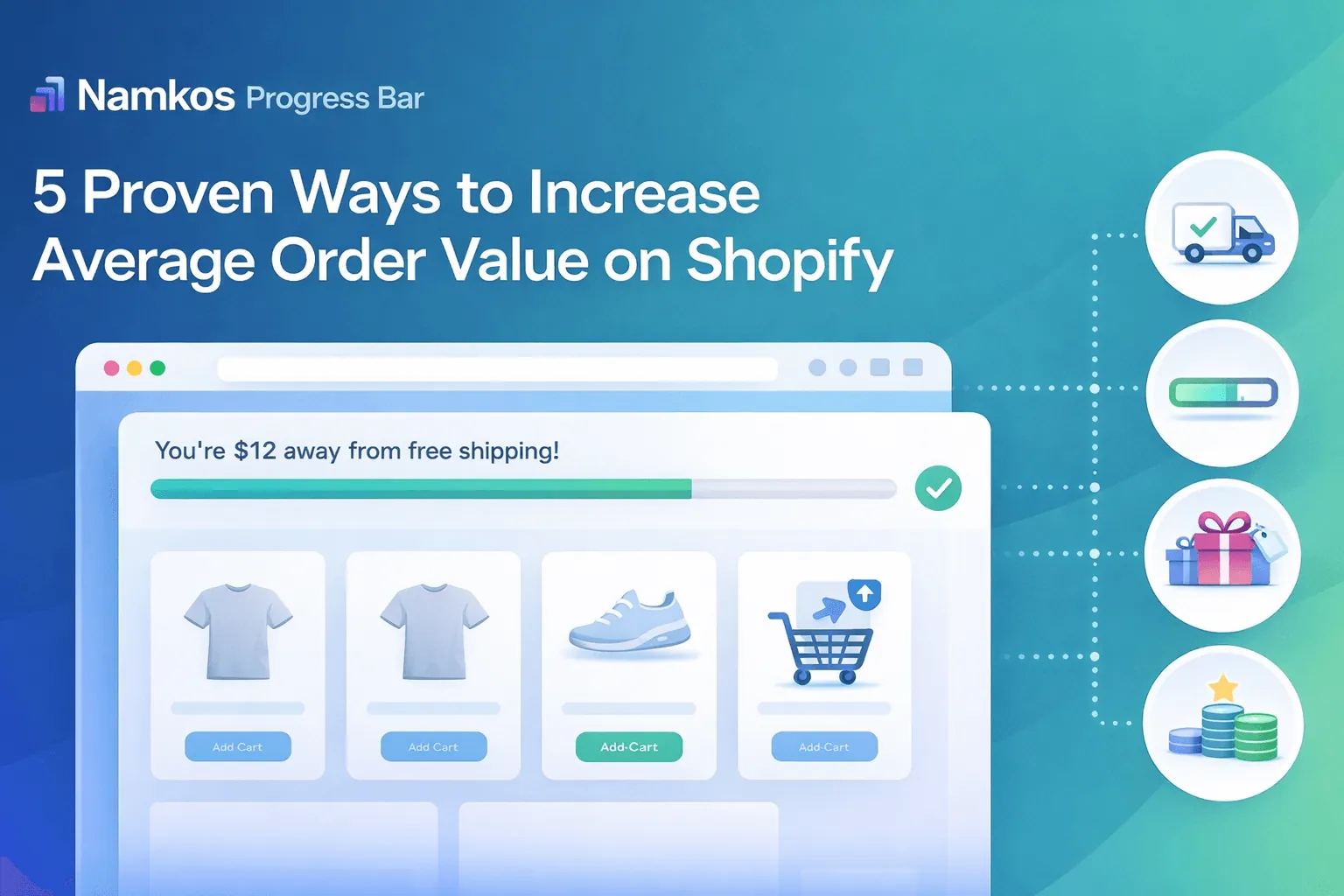
What it is: A visual progress bar that shows customers exactly how close they are to unlocking a reward. "You're $12 away from free shipping" rather than a static text announcement. It's a dynamic, personalised nudge that updates in real time as the cart changes.
Why it works: The goal gradient effect in psychology tells us that people speed up as they get closer to a goal. A progress bar makes the finish line visible. When customers see a bar at 80%, their instinct is to complete it.
The difference between "Spend $50 for free shipping" and "You're $12 away from free shipping" is significant. The first is a demand. The second is a personalised invitation. In our experience with merchants who use progress bars, the visual, real-time approach consistently outperforms static text messaging. Results vary based on niche, traffic, and execution.
How to implement it:
Install Namkos Progress Bar and set up a promotion with your free shipping threshold as the goal. The bar updates in real time as customers add items to their cart.
Namkos Progress Bar supports four reward types: free shipping, percentage discounts, dollar-amount discounts, and free gifts. You can run different promotions for different goals and see which motivates your customers most. If you haven't seen the full breakdown of what the app does, the launch post covers each component in detail.
The free plan includes the top/bottom bar, a product page bar and a cart page bar. Product recommendations inside the product and cart page bars are on the paid plans.
Free Plan Available • No Credit Card Required
Strategy 3: Bundle Products to Increase Basket Size
What it is: Product bundling means grouping two or more related products together and presenting them as a set, sometimes at a small discount, sometimes at full price with added convenience.
Why it works: Bundles increase perceived value. When you present three complementary products as a set, customers who were only going to buy one often end up buying all three. It also simplifies the decision. Instead of browsing for what to add, the bundle does the thinking for them.
How to implement it:
Identify your top-selling products and find natural complements. A skincare brand might bundle a cleanser, toner, and moisturiser as a "daily routine kit." A coffee store might bundle beans, a grinder, and a filter set.
You can build bundles directly on Shopify using product variants, or you can use a dedicated bundling app for more advanced configurations.
The key is to make the bundle feel intentional, not random. Customers should immediately understand why these products go together. A good bundle name, such as "The Starter Kit" or "The Complete Set," helps with this.
Pro tip: Test bundles at the same total price as buying items individually and see if they still sell. If the convenience and curation are the value, you may not need to discount. Keeping margins intact while increasing AOV is the goal.
Strategy 4: Upsell at the Cart Page
What it is: A cart page upsell shows customers a relevant product recommendation right before they complete their purchase, with a simple prompt to add it to their order.
Why it works: The cart page is the highest-intent moment in the buying journey. Customers who have reached the cart have already decided to buy. They're in a spending mindset. A well-timed recommendation of a complementary product at this point can feel helpful rather than pushy.
Cart page upsells consistently produce some of the highest conversion rates of any upsell placement, because the timing is right and the intent is strong.
How to implement it:
There are a few approaches:
- Your Shopify theme: Many themes include a "Customers also bought" or "You may also like" section on the cart page. Check your theme settings first.
- Namkos Progress Bar Cart Component: The cart page component (on every plan) can be paired, on Growth or Scale, with product recommendations. It combines the progress bar (showing how close the customer is to a reward) with product recommendations. This is a powerful combination because it gives the customer both a motivation to spend more and a specific product suggestion to get there.
The most effective cart upsells are relevant, low-friction, and easy to action. If customers have to think too hard about whether they want the suggested product, they'll skip it. Keep the recommendation specific and complementary.
Strategy 5: Introduce Tiered Rewards to Motivate Higher Spend
What it is: Instead of one reward at one threshold, you set multiple rewards at increasing order values. For example: free shipping at $50, a 10% discount at $75, and a free gift at $100.
Why it works: Tiered rewards are one of the most effective AOV strategies because they serve customers at multiple spend levels. A customer who was going to spend $55 might push to $75 when they see a 10% discount waiting. A customer already at $80 might push to $100 for the free gift.
Each tier creates its own goal gradient effect. Customers are always working toward something.
How to implement it:
In Namkos Progress Bar, you can create multiple promotions, each with its own goal amount and reward type. A straightforward setup might look like this:
- Promotion 1: $50 goal, free shipping reward
- Promotion 2: $75 goal, 10% discount reward
- Promotion 3: $100 goal, free gift reward
The app displays each reward as its own bar across your store. Stacked rewards like free shipping and free gifts are always visible, while order discount tiers (percentage or dollar-amount) show one at a time, starting from the lowest goal and automatically advancing to the next tier as each one is reached. This keeps the display clean and focused rather than overwhelming customers with every goal at once.
When choosing your tiers, start from your current AOV and build upward. If your AOV is $42, set the first tier at $55, the second at $70, and the third at $90. Make each tier achievable with one or two additions to the cart.
Note on free gift tiers: You'll need a physical or digital item to offer as the gift. A low-cost, high-perceived-value product works best, such as a sample, a branded accessory, or a digital download. Namkos Progress Bar handles the discount automatically through Shopify, so there's no manual coupon code or order note required.
Putting It All Together: Your Quick-Start Plan
You don't need to implement all five strategies at once. Here's how to prioritise:
This Week:
- Check your current AOV in Shopify Analytics
- Set a free shipping threshold at 20-30% above your current AOV
- Install Namkos Progress Bar and create a promotion to communicate the threshold visually
- Identify your top 3 product pairs for potential bundling
This Month:
- Create your first product bundle and list it as a separate product or variant
- Set up cart page upsells using the Namkos Progress Bar cart component (upsells on Growth or Scale) or your theme's built-in recommendations
- Create a second promotion in Namkos Progress Bar with a higher goal and different reward type
This Quarter:
- Review AOV weekly and adjust thresholds based on customer behaviour
- Test different reward types (free shipping vs. discount vs. free gift) to see which performs best for your audience
- Use advanced analytics to track which promotions are driving the most AOV uplift
In our experience with merchants who implement these strategies, the combination of a clear threshold and a visible progress bar often produces the fastest initial AOV lift. Results vary based on niche, traffic volume, and how your store is set up.
Frequently Asked Questions
What is a good average order value for a Shopify store? AOV benchmarks vary significantly by industry. Fashion stores typically see AOV around $85-95, beauty around $65-75, and home goods around $55-70. The more useful question is: what is your current AOV, and what could it realistically be with a few targeted changes? Setting a threshold 20-30% above your current AOV is a reliable starting point.
Will offering free shipping hurt my margins? It can, if your threshold is set too low. The goal is to set it high enough that the extra items customers add to reach the threshold more than offset the shipping cost. For most stores, a threshold set at 20-30% above current AOV achieves this. Always calculate your average shipping cost and factor it into the threshold decision. Results vary based on carrier rates, product weight, and niche.
Do progress bars work for reward types other than free shipping? Yes. Namkos Progress Bar supports four reward types: free shipping, percentage discounts, dollar-amount discounts, and free gifts. In our experience, discount rewards can be particularly effective for stores where free shipping is already offered unconditionally, because they give customers a different type of incentive to spend more.
How long does it take to see results from these strategies? Some merchants report seeing their first AOV lift within the first week of adding a progress bar and threshold. Bundling and cart upsells typically take a few weeks to gather enough data to evaluate properly. Give each strategy at least 30 days before drawing conclusions. Results vary based on traffic volume, niche, and execution.
Can I run all five strategies at the same time? Yes, and many successful Shopify stores do. The strategies complement each other rather than competing. A progress bar communicates the threshold, bundles increase cart size naturally, and a cart upsell catches customers who are close but haven't quite reached the next reward tier. Start with one or two and layer in the others once you see initial results.
Free Plan Available • No Credit Card Required